Will Weston Figure Drawing Lecture - L1
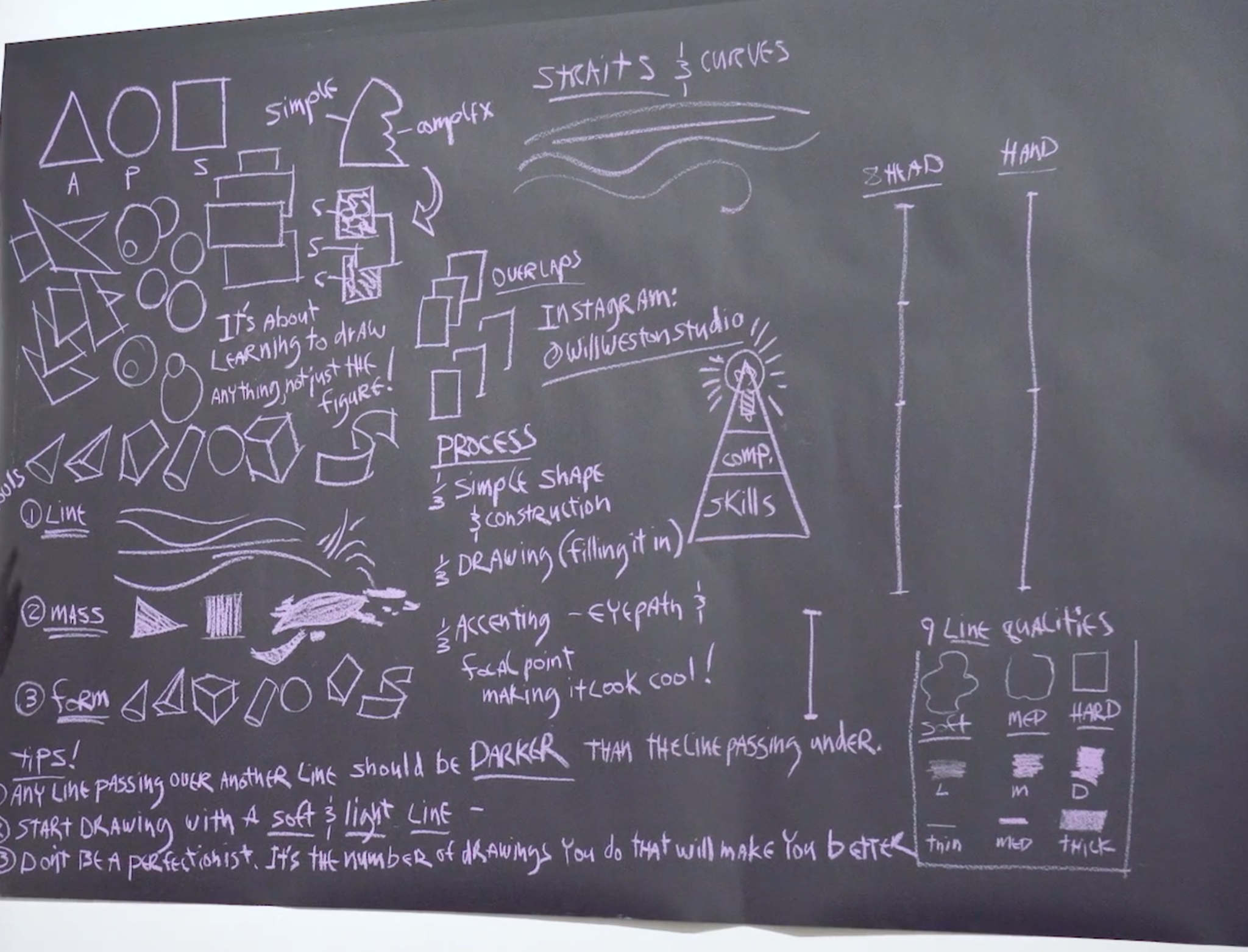
1. Psychological Effect of Basic Shapes
Triangle → tension, instability, sense of movement.
Circle → attracts the eye and keeps attention.
Square → stability, structure, and depth.
2. Core Elements of Drawing
Most drawings break down into three main components:
Line
Mass
Form
3. Mass
Mass can be drop shadows or color decisions.
Some artists work with ratios like:
85% mass / 15% line work
Masses may contain lines, but the viewer should see a shape, not lines.
Composition should include:
One main mass
Supporting smaller masses
Mass adds graphic strength and visual impact.
4. Basic 3D Forms
Objects can be constructed from basic forms:
Cone
Pyramid
Box
Cylinder
Sphere
Prism
Ribbon
5. Simple vs Complex
Drawings balance simple and complex elements.
In animation this principle appears as:
Squash & Stretch
This contrast can exist in:
Lines
Mass
Proximity
Overlaps
These are design tools.
6. Drawing Process
1/3 Thinking
Start with simple flat shapes.
Build construction.
Convert shapes into dimensional forms.
1/3 Expressing
Draw and fill in the forms.
Decide the mass-to-line ratio.
1/3 Accenting
Create eye path.
Define focal point.
Make the drawing visually engaging.
7. Line Qualities
Lines can vary in several ways:
Shape
Soft
Medium
Hard
Value
Light
Medium
Dark
Thickness
Thin
Medium
Thick
Curved lines are usually more visually interesting, while straight lines are accurate but can feel static.
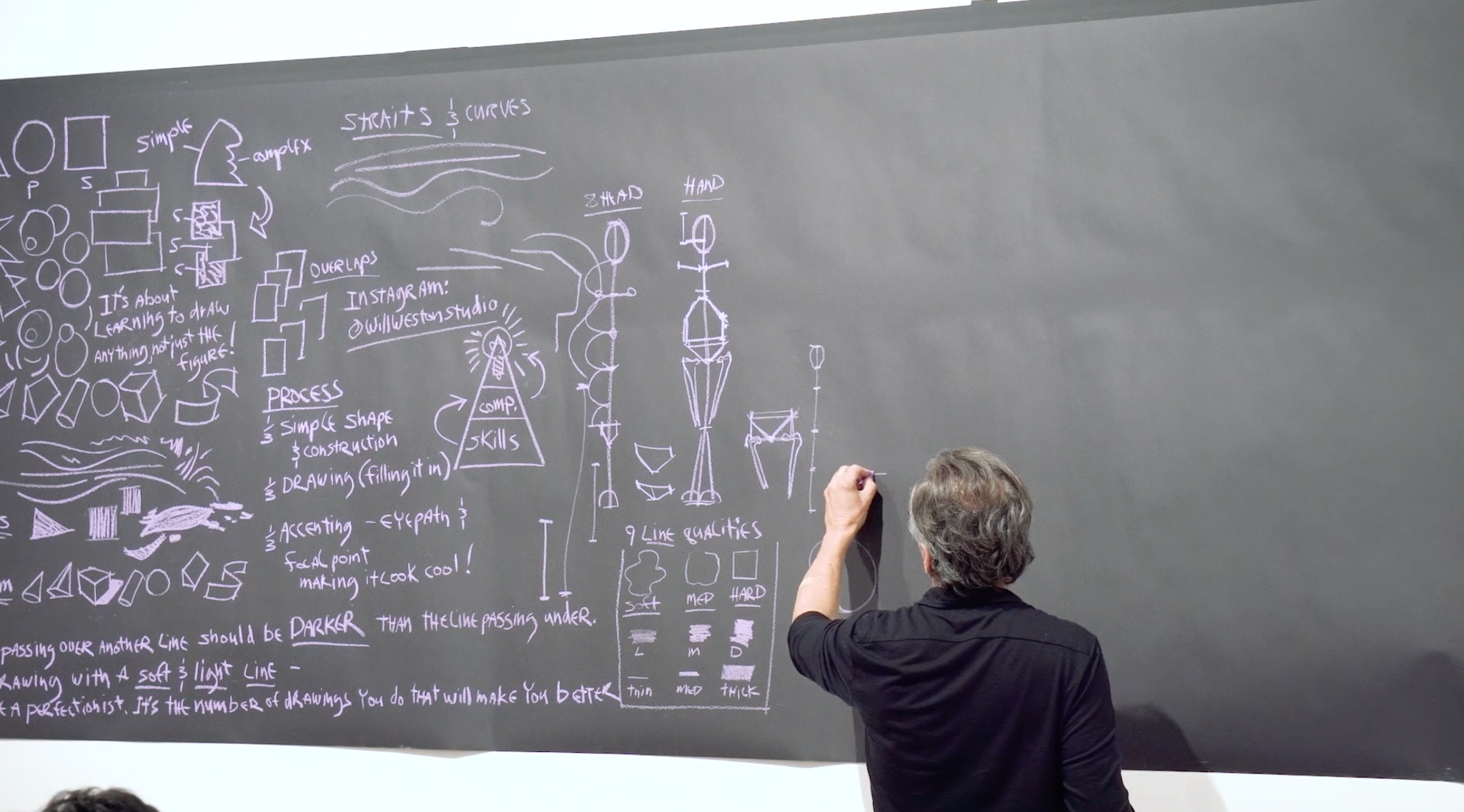
8. Drawing Tips
Line Overlap Rule
The line passing over another line should be darker.
This shows which form is in front and which is behind.
Any line that stops another line is on top.
This creates depth without using light or shading.
This technique was heavily used in 2D animation before 3D.
Start Light
Begin drawing with soft and light lines.
Do not start immediately with strong dark lines.
Avoid Perfectionism
Improvement comes from quantity of drawings, not perfection.
When learning a new technique you often:
take one step back → then two steps forward
Practice exercise:
1 hour session:
2-minute head drawings
then 5-minute drawings
then 10-minute drawings
When you have more time, keep the same pace but push the drawing further.
9. Skills vs Composition
Skills come first.
Then composition.
Composition helps you communicate the idea.
You cannot express the idea without composition, and you cannot build composition without drawing skills.
10. Human Proportion Systems
Eight Heads Model
Body height ≈ 8 heads
Head
Nipples
Belly button
Crotch
Top of knees
Bottom/pillar of knee
Lower leg
Feet
Hand Measurement System
Using the hand as a unit:
Base of nose
Bottom of neck
Base of sternum
Lowest ribs
About three fingers above the crotch bone
Used as a more flexible measurement method when drawing the body.
Core Idea
If you do not yet have a drawing workflow, use this structure:
Shape → Construction → Drawing → Accents (Eye Path & Focal Point)
Then refine it until you discover the process that works best for you.
